


A Book Review on "Bravelands: Shadows on the Mountain: Curse of the Sandtongue" by Erin Hunter

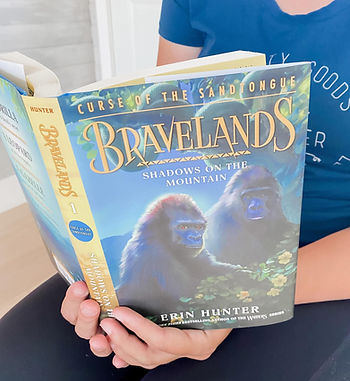
"Bravelands: Shadows on the Mountain" by Erin Hunter is an excellent read. Surprisingly, this is the first Erin Hunter book I’ve had the pleasure of reading, and now I’m definitely a Hunter fan. “Shadows on the Mountain” is the first in her new Bravelands series, and it is quite intriguing. Hunter has a unique way of personifying the animals and her descriptions are unmatched. I often found myself re-reading certain sections just to soak in the incredible wording. Not only am I in love with her writing style, but I feel connected to the characters and their plight. This book is a must and I can’t wait to read what happens to these characters next.
“Shadows on the Mountain” is set in Bravelands, a place that has already been established in Hunter’s previous Bravelands series. This is a place full of various animals and terrain, and unfortunately it’s in danger. The Sandtongue speakers (reptiles of all kinds) are starting to realize their power – due to a massive snake who calls herself She of a Thousand Skins. If that doesn’t give you shivers, I don’t know what will. Three animals, from different walks of life, seem to have been chosen by the Great Spirit to help save Bravelands from this terrifying threat. This book tells their stories and sets up the rest of the series. The Big Bad is introduced and the potential saviours have been chosen.
While I would have liked there to be a bit more resolution in this first book, I completely understand that it’s the first in its series. I’m asking too much, I know. Beyond that one disappointing feature (the fact that I have to wait for more Braveland books), I am in awe of this world she has built, and the terrifying evil that these characters must now face. I really have no idea how they will overcome this evil. And that, in itself, is one of the reasons I love this book.
Recommended Age Group?
It isn’t often that I agree with a publisher’s recommended age group, however in the case of “Shadows on the Mountain” (for ages 8-12), I agree. Also, the fact that I’m 34 and love this book, says a lot.
The only hesitancy I have comes within Hunter’s descriptions. She does such a fantastic job describing what has happened, or how a character feels, that some of her imagery might be a little frightening or gruesome to younger readers. She doesn’t shy away from the idea of predators and prey, and she certainly doesn’t shy away from death. There is a lot of death in this novel, and each one is described perfectly. If you have young readers who are sensitive to animal violence, you may want to wait a couple more years before introducing this series to them.
Hunter also has a tendency to use words that even I am not familiar with. There were many times I had to pull out the old dictionary (i.e. the Internet) and define her vocabulary choices. Don’t get me wrong, I’m not complaining, but your readers are going to have their work cut out for them if they desire to know what each word means. I’m actually ecstatic that Hunter has used so many unknown words, as I find much of today’s 8-12 literature is too easy to read. Books should stretch our minds, and Hunter’s certainly will.
Classroom Approved?
This book is classroom approved, but most likely best suited for grades 4-6. Keep in mind, this book includes some difficult themes, such as death and loss, and offers these descriptions in vivid detail. To determine if this is the right novel for your students/children, I recommend a pre-read before beginning a full class read-aloud.
Your students/children will be wanting to read more of this series and I suspect that many children will get sucked into this vivid world Hunter has created. However, chances are, your children have already dipped their toes into Hunter’s works and already know about this dangerous and beautiful place called Bravelands.
Check out our Novel Study for Hunter's

SP18 Zabrze suggests a numbered primary school identity connected to Zabrze. I would be interested in the practical information a family needs before it can understand the everyday experience behind that name. That is how I think about SP18 Zabrze primary school information. Clear expectations and understandable messages can make school life easier to follow. I like information that anticipates ordinary questions instead of assuming every reader already knows the routines or the meaning of an internal school label.
PZ3 is a short numbered identity, and I would want to know what it represents before drawing conclusions about its educational role. The name itself gives a reader a reference point rather than a complete explanation. That is why context matters to me around PZ3 education identity. I appreciate introductions that explain the audience and purpose in ordinary language. A visitor can then explore with a useful question instead of relying on an uncertain expansion of the initials.
The name Przedszkole 401 points directly to a preschool identity, so early learning feels like the relevant starting point. I am interested in how ordinary activities give young children questions to explore. That is what I associate with Przedszkole 401 early learning. Sorting materials, counting cups, or describing a drawing can each become a useful conversation. I like the idea of adults noticing the thinking behind an attempt, including the ones that need another try, instead of only checking the finished answer.
The preschool identity in Przedszkole Kostrzyn gives cooperation a very practical setting. Carrying materials, deciding where a picture goes, or sharing a turn can create real reasons for children to listen to one another. That is what interests me about Przedszkole Kostrzyn preschool cooperation. I like examples where the task makes the purpose of cooperation visible. A small disagreement can lead to a useful conversation when children have support to explain what they want and understand what someone else needs.
NWYRK is distinctive, but I cannot tell its meaning from the letters alone. That makes a clear explanation of the website's purpose more important than an assumed interpretation of the name. I would approach NWYRK website information with those basic questions in mind. Who is it for, what subject does it cover, and where should a reader begin? I like information that answers those questions directly, because it gives an unfamiliar identity a useful context without relying on invented associations.